India’s equity market has several indices that track different segments of the economy. The Nifty India FPI 150 Index takes a different approach by focusing on companies that are particularly relevant from a Foreign Portfolio Investor (FPI) perspective.
The index provides investors and traders with a way to track a diversified basket of Indian companies based on factors such as foreign investibility, free-float market capitalization and liquidity.
But what exactly is the Nifty India FPI 150, how are its stocks selected, and how can market participants gain exposure to it?
What Is the Nifty India FPI 150 Index?
The Nifty India FPI 150 Index consists of 150 stocks selected from the Nifty 500 universe.
Unlike a conventional large-cap or sectoral index, its methodology places greater emphasis on characteristics that matter to foreign portfolio investors, including:
Other eligibility requirements defined under the index methodology
In simple terms, the index aims to represent Indian companies that are relatively accessible and relevant to foreign portfolio investors.
The index has a base date of October 3, 2022, and a base value of 1,000.
How Are Stocks Selected?
The selection universe begins with companies included in the Nifty 500.
Eligible stocks are then assessed according to the index methodology, with particular consideration given to their foreign investment capacity, free-float market capitalization and market liquidity.
The index is rebalanced quarterly. This means that its constituents and their respective weights may change periodically as market conditions, company valuations and foreign investment characteristics evolve.
This periodic rebalancing helps the index remain aligned with its objective of representing stocks that are relevant from an FPI perspective.
How Can You Trade the Nifty India FPI 150?
An important development for active market participants is the availability of derivative contracts based on the index.
Futures
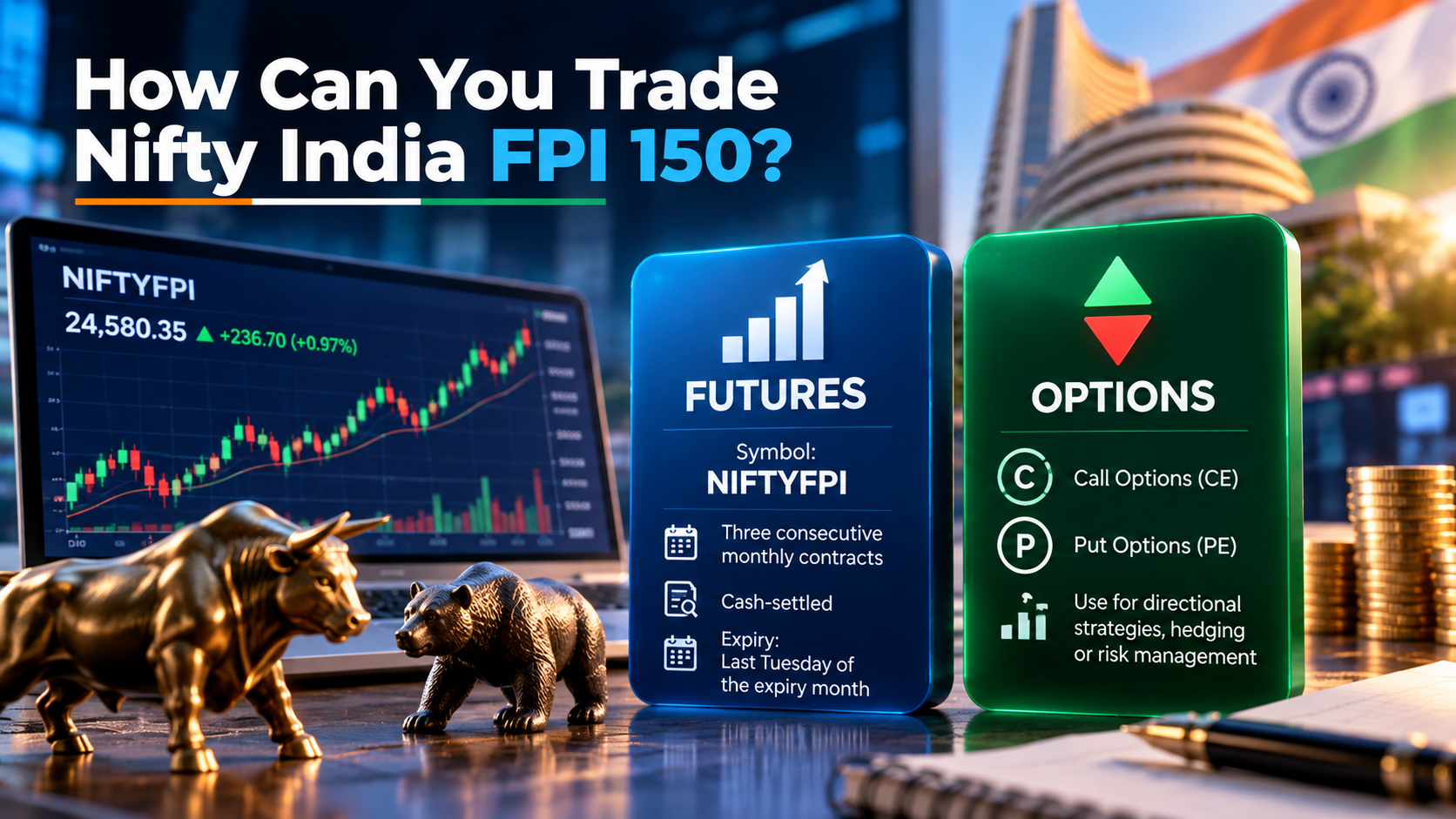
Nifty India FPI 150 Futures are traded under the symbol NIFTYFPI.
Futures allow traders to take a directional position on the overall index without having to individually buy or sell all 150 constituent stocks.
Contracts are available across consecutive monthly expiries and are cash-settled. The applicable contract specifications and expiry schedule should always be verified with the exchange before placing a trade.
Options
Options contracts are also available on the index, including:
Call Options (CE)
Put Options (PE)
Depending on their market outlook, experienced traders may use Futures or Options for directional strategies, portfolio hedging or risk management.
For example, a bullish market view may be expressed through certain Call-based or Futures strategies, while Put-based or short Futures strategies may be considered when the outlook is bearish.
However, derivatives involve significant leverage and risk, and losses can be substantial. Traders should understand contract specifications, margin requirements, volatility and risk-management principles before participating.
Why Is the Nifty India FPI 150 Important?
Foreign Portfolio Investors play an important role in Indian capital markets. Changes in global liquidity and investor sentiment can therefore have a meaningful impact on Indian equities.
The Nifty India FPI 150 can provide an additional lens through which investors can observe stocks that are particularly relevant to foreign investors.
During periods of improving global risk appetite and stronger foreign investment flows, companies represented in the index may attract increased market attention.
Conversely, sustained FPI selling may create pressure on foreign-investor-sensitive segments of the market.
Some important factors that can influence FPI activity include:
US interest rates and bond yields
Movement in the US dollar
Global equity market sentiment
Crude oil prices
Geopolitical developments
India’s economic growth outlook
Domestic inflation and interest rates
Corporate earnings
Global risk appetite
Therefore, the index may also serve as a useful reference point when studying the relationship between global capital flows and Indian equities.
Nifty 50 vs Nifty India FPI 150
Although both indices represent Indian equities, their objectives are different.
The Nifty 50 primarily tracks 50 of India’s largest and most liquid companies across major sectors and is widely used as a benchmark for the broader Indian equity market.
The Nifty India FPI 150, on the other hand, focuses on a broader basket of 150 companies selected with greater emphasis on foreign investibility, free-float availability and liquidity.
As a result, the composition and weightings of the two indices can differ considerably.
This also means that the Nifty India FPI 150 and Nifty 50 may not always perform in exactly the same manner.
What Should Investors and Traders Watch?
Anyone tracking the Nifty India FPI 150 should pay particular attention to developments that can influence foreign capital flows into India.
Key indicators include FPI buying and selling data, US Treasury yields, the US dollar, crude oil prices, global equity markets, central-bank policy and geopolitical developments.
Rather than looking at any one factor in isolation, market participants should consider how these variables collectively affect global liquidity and investor appetite for emerging markets such as India.
Bottom Line
The Nifty India FPI 150 Index offers a different perspective on the Indian equity market by focusing on a diversified basket of companies that are particularly relevant from a foreign portfolio investor standpoint.
The availability of Futures and Options also makes the index relevant to traders seeking directional exposure or hedging opportunities.
However, the index should not be viewed simply as a predictor of FPI activity. Foreign investment flows are influenced by several domestic and global factors, and market movements can change rapidly.
For investors and traders, the Nifty India FPI 150 is best viewed as another useful tool for understanding how foreign capital, global market conditions and Indian equities interact.
Disclaimer: This article is intended solely for educational and informational purposes and should not be considered investment, trading or financial advice. Investments and trading in securities and derivatives involve market risk. Readers should conduct their own research and consult a qualified financial professional before making investment decisions.