Why Did the Indian Stock Market Fall Today? Key Factors Behind the Sell-Off
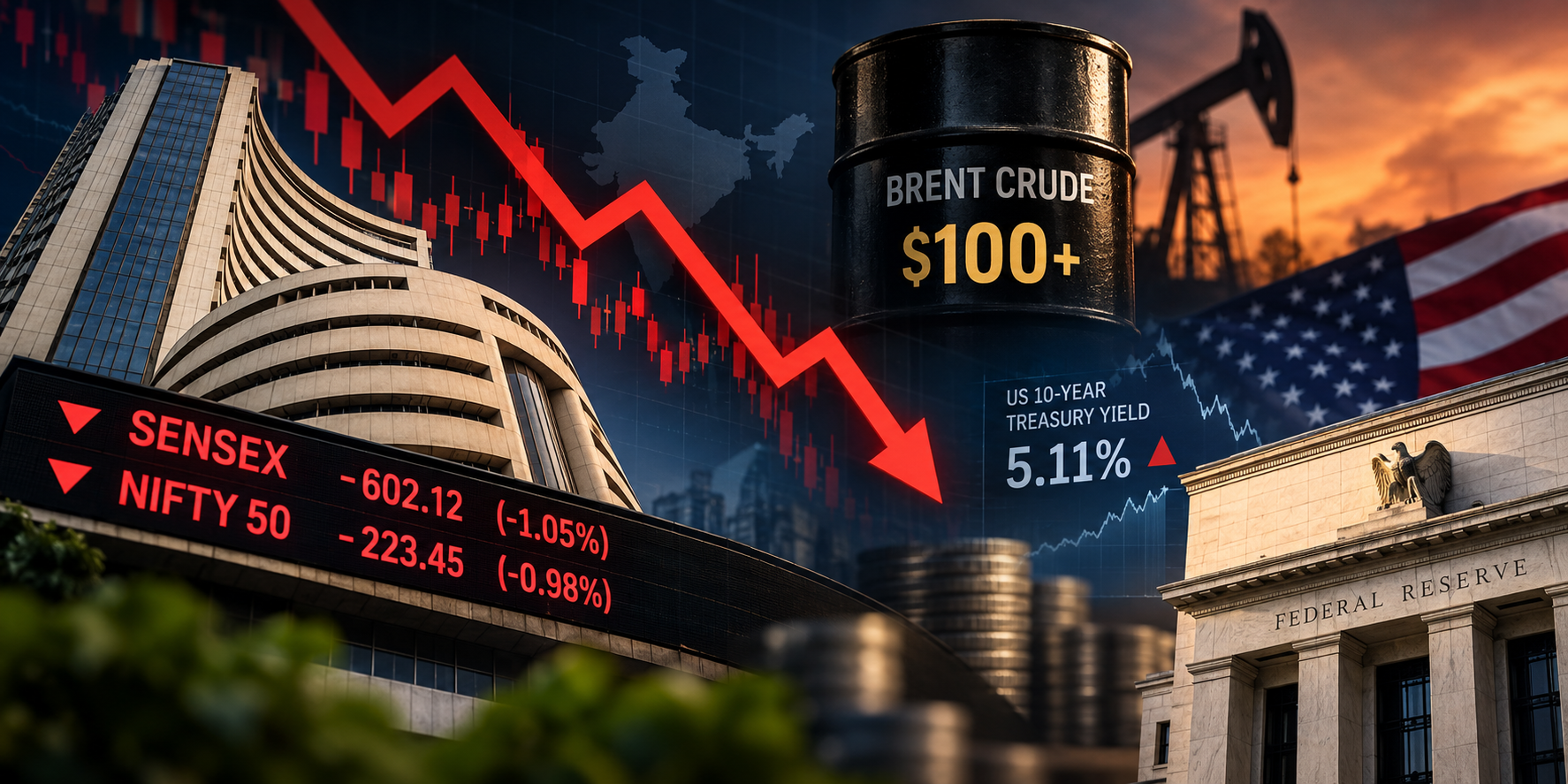
The Indian stock market came under significant selling pressure on Thursday, with the Sensex falling more than 600 points at one point during the session, while the Nifty 50 slipped nearly 1%.
But what triggered the decline, and why are investors becoming cautious?
The sell-off appears to reflect a combination of rising crude oil prices, higher US bond yields, changing interest-rate expectations and persistent global uncertainty. Here’s a closer look at the key factors influencing market sentiment.
1. Rising Crude Oil Prices: A Concern for India’s Economy
One of the key factors weighing on investor sentiment is the rise in crude oil prices. Brent crude has moved back above the $100-per-barrel mark, raising concerns about India’s import bill, inflation and corporate profitability.
India relies heavily on imported crude oil to meet its energy requirements. When oil prices rise, the impact can extend across several parts of the economy.
Higher import costs: Rising crude prices can widen India’s import bill and put pressure on the current account.
Inflationary pressure: Higher energy and transportation costs can contribute to inflation.
Corporate margin pressure: Oil-intensive sectors such as aviation, paints, chemicals and logistics may face higher input costs.
For investors, sustained high crude oil prices can create concerns about economic growth, inflation and corporate earnings.
2. Rising US Bond Yields: Pressure on Equity Valuations
Another important factor is the movement in US Treasury yields. The US 10-year Treasury yield has reportedly climbed to around 5.11%, drawing attention from global investors.
US Treasury yields are closely watched because they influence global borrowing costs and investment decisions. When yields rise, bonds may become more attractive relative to equities, particularly for investors evaluating risk and return.
Higher yields can also put pressure on equity valuations by increasing the discount rate applied to future corporate earnings.
For emerging markets such as India, a sustained rise in US yields may also contribute to foreign investor outflows and currency-market pressure, depending on broader global conditions.
3. US Federal Reserve Uncertainty: Markets Reassess Rate Expectations
Investors are also keeping a close eye on the US Federal Reserve’s interest-rate outlook.
Recent economic data has influenced expectations around the Fed’s next policy moves. If markets begin anticipating interest rates to remain elevated for longer, investors may become more cautious about riskier assets.
For equity markets, the concern is twofold: higher interest rates can increase financing costs, while elevated discount rates can weigh on valuations.
This uncertainty can become particularly relevant when equity valuations leave limited room for unexpected changes in the global economic environment.
4. Banking and Financial Stocks Add to Market Weakness
The pressure was not limited to global macroeconomic factors. Banking and financial stocks also faced selling pressure, contributing to the broader market decline.
Given the significant weight of financial stocks in benchmark indices such as the Nifty 50 and Sensex, weakness in this sector can have a considerable impact on overall market performance.
When selling spreads across heavyweight sectors, it can amplify benchmark losses and weigh on investor sentiment.
5. Global Geopolitical Uncertainty Keeps Investors Cautious
Geopolitical developments remain another important variable for global markets, particularly when they influence energy supply, crude oil prices or inflation expectations.
Uncertainty surrounding global developments can lead investors to reassess risk exposure, reduce positions in equities and move towards relatively safer assets.
When geopolitical concerns coincide with rising crude prices and higher bond yields, the combined effect can intensify volatility in equity markets.
What Should Investors Watch Next?
The recent decline highlights how closely the Indian stock market remains connected to global economic and financial developments.
Over the next few trading sessions, investors may closely monitor the following indicators:
Key Indicator
Why It Matters
Brent crude oil prices
Signals potential pressure on inflation, imports and corporate costs
US 10-year Treasury yield
Influences global borrowing costs and equity valuations
US Federal Reserve commentary
Shapes expectations around future interest rates
Foreign institutional investor (FII) flows
Provides insight into foreign investor positioning
Banking and financial stocks
Can influence benchmark index performance
The direction of these indicators may help investors assess whether the current weakness is a short-term bout of volatility or part of a more sustained market correction.
Finkosha Analytics Takeaway
Today’s market decline should not be viewed as the result of a single event. Instead, it reflects the interaction of multiple factors — rising crude oil prices, elevated US bond yields, uncertainty around monetary policy and broader geopolitical risks.
For investors, the key is to distinguish between short-term market volatility and changes in underlying economic and corporate fundamentals.
While near-term market movements may remain sensitive to global developments, investment decisions are better evaluated through an individual’s financial goals, risk tolerance, investment horizon and portfolio allocation rather than a single day’s market performance.
At Finkosha Analytics, we believe informed investing begins with understanding the forces driving the market — not merely reacting to its movements.
Disclaimer: This article is for educational and informational purposes only. It should not be construed as investment advice, a recommendation to buy or sell securities, or a guarantee of future market performance. Please consult a SEBI-registered investment adviser before making investment decisions.